News surf Côte Basque & Landes
Comprendre la marée, les super-marées, et les mascarets
21 September 2023
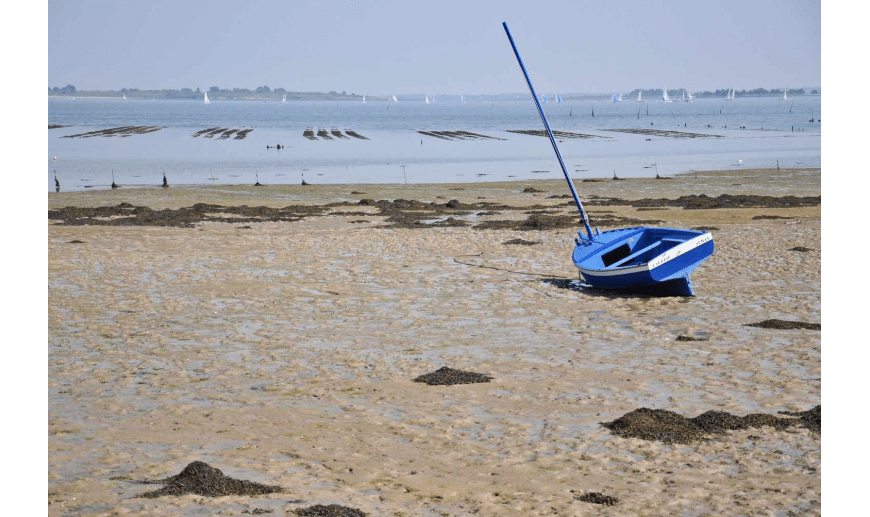
WHAT IS THE TIDE?
The tide refers to the rising and falling movement of the oceans and seas. It is caused by the moon’s gravitational pull on the sea, as well as by the Earth’s rotation, which generates a centrifugal force.

LE PHÉNOMÈNE DE SUPER MARÉE OU VIVES-EAUX.
The phenomenon of a spring tide occurs during a celestial alignment: when the Earth, the Moon, and the Sun are aligned in a specific configuration called a syzygy.

During a spring tide, the tidal force is maximized due to the Moon’s alignment and proximity.
- High tides (rising tides) are higher
- Ebb tides (outgoing tides) are lower than during normal tides.
This tidal amplification can lead to a significant increase in wave height, which can make surfing conditions more powerful and intense.
THE DEAD-WATER TIDES
In contrast, there are neap tides, which occur when the Moon and the Sun are aligned perpendicular to the Earth. This configuration limits the amplitude of tidal variations by reducing the difference between high-tide and low-tide water levels.

This phenomenon can make surfing conditions less exciting for surfers looking for dynamic waves. However, the waves may be more consistent and predictable, which can be an advantage for less experienced surfers.
WHEN IS THE BEST TIME TO SURF IN BIARRITZ, BASED ON THE TIDES?
It’s best to surf at mid-tide or low tide on the beaches of Biarritz and the surrounding area. Generally speaking, for beginners, a good tidal range is between 50 and 80.
- The waves are better suited for beginners. At low tide, the ocean floor is flat all the way to the shore break (where the waves break at high tide). The waves are then more consistent and easier to surf. They are also smaller at low tide, which makes them less dangerous for beginners.
- There’s more room to surf. The beach is bigger (see diagram above), which provides more space.
- It takes less effort to paddle. At low tide, the water is shallower, which makes paddling easier—and even allows you to pull your board along on foot to catch waves further out. This is important for beginners, as it helps them tire less quickly.
Warning! At high tide, rip currents and offshore currents can form. Every year, many swimmers are swept out to sea and are unable to return to the beach. However, once you understand how they work, rip currents can be very useful for surfers trying to reach the lineup.
We’ve put together a list of beaches in the area where you can start surfing if you come visit us—feel free to check it out on our blog.

TIDAL PHENOMENA: TIDAL BURSTS
Mascaret waves are unusual waves that form during the tidal turn. They travel upriver against the current and can create impressive waves.
Here are three points to summarize the tidal bore:
- Mascaret waves are tidal waves that travel upriver.
- They form during the tidal change, when the water level rises.
- In Bordeaux, also known as the “Dordogne Waves,” the mascaret waves can reach heights of up to 1.5 to 2 meters on average under ideal conditions.
Tidal bore phenomena are a natural occurrence that attracts many tourists and sports enthusiasts. They are also a significant economic asset for the regions where they occur, as they help foster activities such as tourism, fishing, and boating. In Gironde, the next tidal bores are forecast for August 30 and 31, 2023.

Source: The Saint-Pardon tidal bore, as seen from a drone last September. © Photo credit: Guillaume Bonnaud / SUD OUEST