News surf Côte Basque & Landes
Tips for Beginners Looking to Start Surfing in the Basque Country
20 September 2023
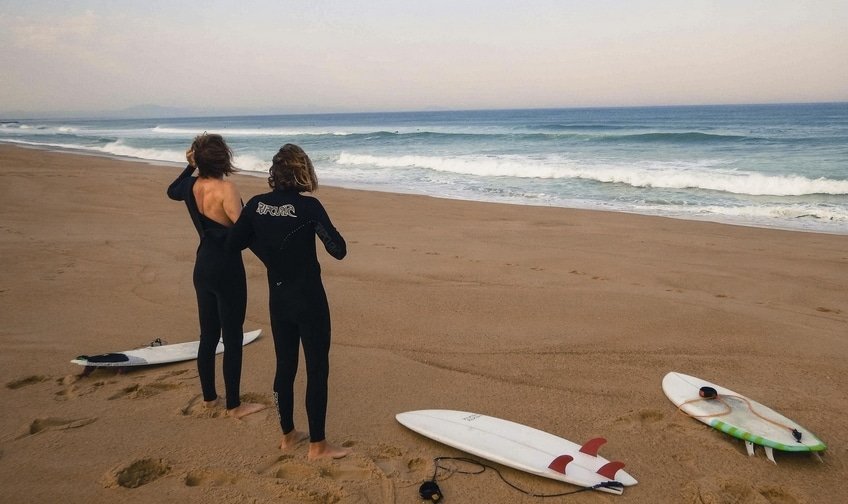
TIPS FOR BEGINNERS TO SURFING IN THE BASQUE COUNTRY
Haven’t you ever dreamed of being an expert surfer and having your own photo taken inside a tube? Well, you should know that anyone can learn to surf…
You just need to be motivated, dedicated, and practice as much as possible! Don’t worry—after a week of intensive surfing, you’ll be able to catch your first waves and experience that thrill. To become a pro, it’ll take a few more hours… But as with any sport, you have to start as a beginner before you can become an expert.
If you want to start practicing safely and learn quickly, we have some great tips, resources, and safety rules for you.
METHODS FOR LEARNING TO SURF
– The first: learning to surf on your own
It is possible to learn to surf on your own. It’s not recommended, but you can give it a try. If you do, be sure to stop by the store so our team can recommend the perfect surf spot for you to get started safely. Our staff will check the forecast to find the right beach for you and rent you the right surfboard so you can make progress on your own. Plus, if you’re improving quickly, don’t hesitate to stop by the store again to pick up a different board so you don’t hit a plateau in your progress. The team will help you choose the right gear to get started.
– The second: take surfing lessons
As you can see, when it comes to safety and how quickly you learn, the best option is to take lessons. For many people, about ten hours are enough to get up on the board and ride the wave all the way to the shore.
Surf Schools in France
– The French Surfing Federation’s network
It includes more than a hundred certified schools and clubs throughout France and in the overseas departments and territories. For example, if you’re vacationing on the Basque Coast, there’s a certified water sports school in Bidart.
– Les écoles de surf de Bretagne
The Breton surf school network operates across a large part of the region. Equipment is provided for safe practice sessions with instructors.
– Unaccredited surf schools
Instructors who have their French diplomas, but who do not belong to the French or Breton label.
THE PERFECT PLACES TO LEARN TO SURF
When starting out, you should surf beach breaks—sandy beaches. Obviously, if you haven’t mastered board control and the take-off, you are safer on a wave with a sandy bottom than on one with a rocky bottom.
To learn to surf, the French coasts have sublime waves. Whether you are in Brittany, Gironde, Landes or the Basque Country you will be able to find what you are looking for. It is still important to know that the south-west of France is the coast which best captures the swell. There are therefore more waves in the Landes and the Basque Country. Summer is a season where the swell is often smaller, so to be sure you can surf during your week of vacation it is advisable to go to the Landes or the Basque Country.
If you are looking for an example of a surf spot, Pavillon Royal Beach in Bidart is perfect for learning to surf; it is a safe beach that easily picks up the swell.
SURFING SAFETY RULES
- The main rule for a beginner should be: Only one person per wave.
Only one surfer rides the wave to avoid collisions. Priority goes to the person already riding the wave; if no one is on the wave yet, it goes to the person closest to the breaking water (the foam).
- Do not surf in the swimming area (blue flags).
You risk a fine, but above all, injuring swimmers.
- Don’t fight the current.
It is easier said than done, but if you feel yourself being swept away, let the current carry you. Once you are out of the current, you can calmly make your way back to the shore. Don’t worry—it usually only involves a distance of a few meters.
- If the beach has a designated surfing zone, you must practice within that area.
The flag is green with a red circle and is often located near the swimming area. Don’t hesitate to ask the lifeguards.
- Don’t go surfing in big waves if you aren’t ready.
If you are a beginner, do not go out in waves higher than one meter. In fact, if you are afraid, do not enter the water; you could panic and put both yourself and other water users at risk. If you are unsure about the wave height, do not hesitate to ask the lifeguards.
- Never let go of your board when paddling out.
If you let go of your board, you risk injuring others. Plus, if you want to learn how to duck dive, now is the time. You need to try passing under the waves with your board. It’s tricky at first, but repetition is key to getting the timing right.
Which surfboard should you choose to start surfing?
For beginners, it is not recommended to spend several hundred euros on a surfboard; it is better to start by renting equipment.
You can rent equipment from specialized shops—like ours. These shops offer boards for everyone from beginners to experts, giving you the time to hone your skills and find the perfect board for you. Whether you are just starting out or want to try different models to find the right fit, our quiver has exactly what you need!
Now dive into the water,
Enjoy surfing,
Marty